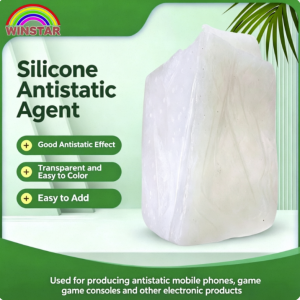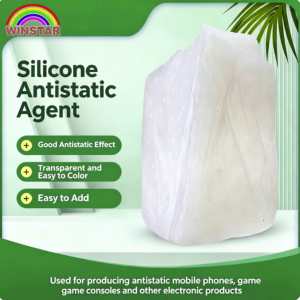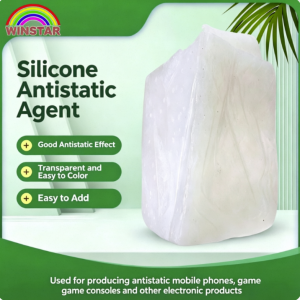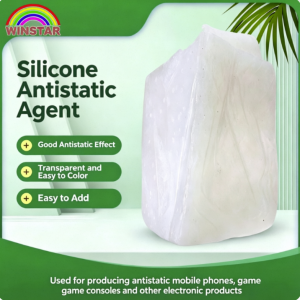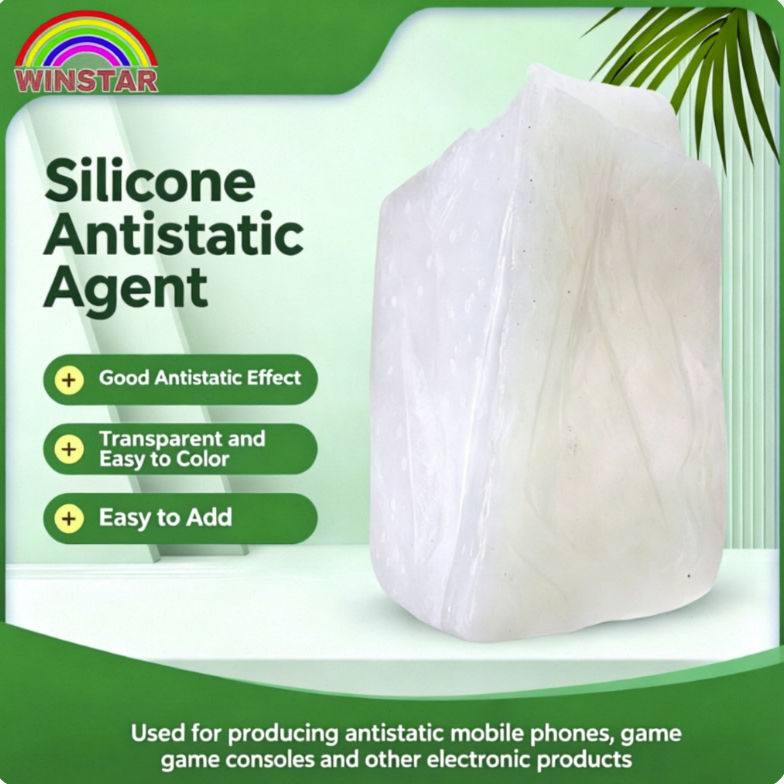
Silicone Anti-Static Agent Frequently Asked Questions
Here we have sorted out the most common questions from our global customers about our silicone anti-static agent, covering
product performance, usage, compatibility, safety and after-sales support to help you make quick and accurate purchasing decisions.
1. Product Performance & Principle
A: It is a permanent internal anti-static additive. Different from surface spray coatings that are easy to wear off, it is uniformly
dispersed inside the silicone matrix to form a stable conductive micro-network. The ESD effect will not disappear due to long-term
friction, wiping, washing or aging, and lasts for the entire service life of silicone products.
Q2: What is the stable surface resistance range after adding the agent?
A: With standard dosage, the surface resistance of finished silicone products is stably controlled at10⁶–10⁹ Ω/sq, which fully meets
industrial anti-static, dust-proof and ESD protection standards for electronic workshops.
Q3: Will it fail in low-humidity and dry environments?
A: No failure. Our internal modification technology is not dependent on environmental humidity. It can maintain stable anti-static
performance in dry indoor, high-temperature and low-humidity working environments, solving the common defect of traditional
hygroscopic antistatic agents.
2. Compatibility & Product Appearance
A: Yes. It has ultra-wide compatibility, perfectly applicable to LSR liquid silicone, HTV solid silicone, silicone gel, silicone sealant,
silicone foam and silicone adhesive, covering almost all silicone molding processes.
Q5: Will it affect the transparency and color of silicone products?
A: Our transparent-grade anti-static agent will not cause yellowing, turbidity, blooming or whitening on the surface of transparent
silicone products. It can well maintain the original high transparency and appearance of silicone materials.
Q6: Will it change the physical properties of silicone?
3. Usage & Production Process
A: The conventional addition ratio is 1%–5% by weight of silicone raw materials. The specific dosage can be adjusted flexibly
according to your target resistance value and product usage scenario.
Q8: Is extra production equipment or process adjustment required?
A: No extra modification is needed. Just mix and knead it evenly with silicone base rubber in the rubber mixing or stirring process,
then follow your original vulcanization, injection molding and curing procedures. It is fully compatible with standard silicone
production lines.
Q9: Can it withstand high-temperature silicone vulcanization?
A: Absolutely. The product has excellent thermal stability, resisting high temperature of 200–230°C without decomposition,
volatilization or performance attenuation, adapting to conventional high-temperature vulcanization processes.
- Hi, Winstar Silicone company, we are interested in your product silicone color masterbatch, could you please offer some free samples to us? Our company address: ***LA,USA
- Hello Winstar, our product is compression molding product,could you advise which peroxide curing agent to use ?
- Hi friend, we have some problem in silicone to PVC bonding, that bonding strength is not well at all, how to improve it please ?